The works starting in Spring 2026 are highway works, known as Central Stort Crossing North, to provide increased capacity at the existing Eastwick Road (A414) /Fifth Avenue roundabout and its approaches. The existing roundabout will be replaced by a signal-controlled junction maintaining the existing two lanes whilst providing a dedicated right turn lane from the A414 eastbound onto Fifth Avenue.
The works are a requirement of the Gilston Area planning consents for 10,000 new homes, associated infrastructure and community amenities. They provide the required additional highway capacity, and form part of the wider Harlow and Gilston Garden Town project – a vision to create 16,000 new homes, new schools, community facilities, essential services, and 1,600 new jobs. (HGGT) new sustainable transport network which will help relieve existing highway congestion.
The works include new dedicated cycle, pedestrian and bus routes to promote sustainable travel in the wider area. By putting good transport in place early, it allows new homes and workplaces to be built without adding pressure to the existing network. It also opens opportunities, connecting people to work and services, whether or not they own a car, while helping Harlow and the surrounding areas grow in a way that’s cleaner, fairer and better for future generations.
The Central Stort Crossing North project is expected to complete by Winter 2028.
We recognise that any major infrastructure project brings temporary disruption, and we are committed to minimising this wherever possible. The current proposals are the outcome of liaison with Hertfordshire County Council (HCC) Highways, who are the statutory approving authority for traffic management on the local road network. They reflect key considerations across the wider network, including the impacts on local residents and businesses, access for emergency services and public safety.
We will continue to actively look at ways to mitigate the impact of road closures, throughout the project. The works are complex and the order and timing of works will be subject to change.
Yes. We recognise that full road closures are disruptive and that this is a major concern for local residents. Unfortunately, some limited periods of full closures of Eastwick Road will be necessary to safely deliver the works.
Over the 2.5‑year programme, there will be limited periods when Eastwick Road must be closed in both directions. The first of these is currently proposed as a seven‑week closure of Eastwick Road as early as October 2026. However, please note, that due to the complexity of these works this may change.
The requirement for full closures has been developed through extensive discussion with Hertfordshire County Council (HCC) as the Highway Authority, with a strong focus on minimising overall disruption wherever possible. Key considerations have included:
Safety considerations: The works involve complex drainage, new utility infrastructure and utility diversions. Highway standards require utilities to be grouped together within adoptable highway footprint where possible, creating a large, combined trench. These works typical are done early in the construction of new highway works to make space for the new highway widening. During these periods it would not be safe for traffic and pedestrians for the existing road to remain open.
Protecting the wider road network: Keeping Eastwick Road open would require three‑way temporary traffic signals. HCC Highways has advised that this would lead to significant congestion and tailbacks on the A414 and Fifth Avenue which would result in a bigger impact on residents’ emergency vehicles using this route.
Network impact: HCC Highways has advised that fewer, longer closures are overall less disruptive to local residents than a series of shorter but more frequent closures spread across the network.
Reducing overall disruption: While closures are disruptive in the short term, completing works more efficiently helps shorten the overall duration of traffic management and associated impacts on local residents.
The diversion routes are designed to use the safest, shortest and most suitable route available and must use roads of the same classification or higher as the road being closed. All works will be monitored throughout the course of the project. See image for route.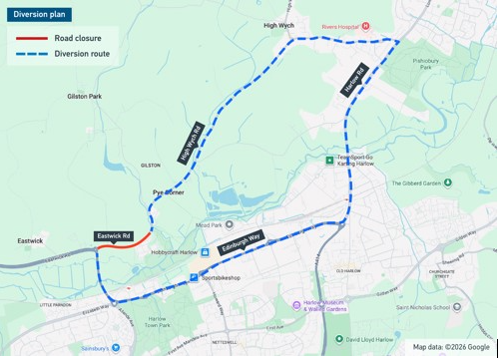
Whilst 24-hour working hours are agreed to be used in certain circumstances, the sequencing of works required for the road closure would not directly change the overall closure timeframe.
The roadworks required will mean trenches will span across the main carriageway. It is not possible, or safe, to fill the road in each morning to reopen it each night.
All options were considered to limit the extent of full road closures required to deliver these works safely whilst minimising congestion. Wherever possible works will be complete with one lane open under traffic lights.
Full road closures will be kept as short as possible, but the works involve diverting multiple utility services, requiring coordination with several third parties.
Reopening the road in evenings or at weekends is not practical due to the scale of works and the time needed to reinstate safety, which would extend the overall closure period. Night-time working is also unsuitable.
Extended working hours will be used to allow the contractor greater flexibility, enabling faster delivery and better management of unforeseen issues, with the aim of minimising the total duration of road closures.
Yes. Pedestrian access will be maintained at all times. Access between Terlings Park and Burnt Mill Lane will remain open for pedestrians, allowing continued access into Harlow.
No. Burnt Mill Lane cannot be opened to vehicles as the bridge over the River Stort does not have sufficient structural capacity.
Burnt Mill Lane is not a through road but will be accessible for business and resident access only during the road closure. Road users will need to follow the diversion and enter from the Eastwick Road end.
Road users will be able to access the businesses and homes by following the diversion. During the road closure there may be times when Burnt Mill Lane will be subject to two-way traffic light controls.
Hertfordshire County Council, Essex County Council and Places for People are looking to see if any access can be granted over the weak bridge, for emergency services only, for the duration of the road closure.
Access to the Moorhen pub will be retained during the road closure. Hertfordshire County Council, Essex County Council and Places for People are looking to see if any access can be granted for emergency services only, over the weak bridge for the duration of the road closure.
For the duration of the road closure, traffic lights will be added at the junction of High Wych Road and Harlow Road to alleviate pressure on the junction.
Access to all properties and businesses will be retained during the road closure, however, access to any businesses along High Wych Road will only be accessible from Harlow Road.
In partnership with TriConnex – who are delivering these works, Hertfordshire County Council Highways Authority and PfP, TriConnex have adjusted their programme. Works will now complete along Parsonage Lane on 5 October 2026.
The 33A bus from High Wych to Harlow will now operate via Redricks Lane and will not stop at bus stops in Gilston. People will be able to access the bus from the stops either side of Gilston, being Harlow Edinburgh Way or High Wych Rising Sun pub.
The 33 bus will terminate in Gilston and will provide a service between Gilston and Bishop’s Stortford.
A free 33H bus will be implemented from Gilston to Harlow via Redricks Lane and will run non-stop to the Harlow Centre.
Connections for Hoddesdon will be advertised on the 25 route.
The highways contractor has submitted their programme of works and is finalising their road space approvals with Hertfordshire County Council. The works are complex- during the course of the works there may be some adjustments to the dates to react to issues not in our direct control or to deal with matters that could not have been foreseen. Advance notice of traffic management dates will be displayed on roadside signs.
Yes. Access will be maintained to all properties at all times throughout the works.
The temporary closure of the central reservation crossover has been implemented for safety reasons as part of the wider works. During this period, vehicles are only able to turn left into and out of Eastwick Village, with traffic diverted via the signed diversion route. The crossover will remain closed while these works are being undertaken.
We are aware that some road users were interfering with the previous traffic management, which not only increased the risk of an accident, but constitutes as an offence.
We recognise residents’ concerns on this matter, but the approved arrangements will remain in place.
No programme can be guaranteed but all efforts will be taken to complete on time, or earlier where possible.
We recognise that full road closures are disruptive and that this is a major concern for local residents. Unfortunately, some limited periods of full closures will be necessary to safely deliver the works.
Over the 2.5‑year programme, there will be limited periods when Eastwick Road must be closed in both directions. The first of these is currently proposed as a seven‑week closure of Eastwick Road as early as September 2026.
The requirement for full closures has been developed through extensive discussion with Hertfordshire County Council (HCC) as the Highway Authority, with a strong focus on minimising overall disruption wherever possible.
Roadworks and traffic management do not operate under a consultation process. In April 2026, PfP hosted a community drop-in session for residents sharing the full programme of works to enable them to prepare for the proposed Autumn road closure. The diversion was published on the gilstonparkestate website in April 2026.
The road closure was authorised in late August 2026 and is in line with original programme of works. To keep residents informed the following communications were issued:
• HGGT circulated a resident communication by post on 1 September 2026
• PfP issued a press note, updated the gilstonparkestate website and issued a newsletter to impacted residents ahead of the closure.
• PfP presented the proposals to local councillors and parish councillors on 9 September 2026 and then again at the East Hertfordshire District Council Community Forum on 9 September 2026.
• Hertfordshire County Council, Harlow and Gilston Garden Town and other partners shared on their social platforms in early September 2026